

A 10x productivity improvement does not mean your finance team works ten times harder.
It means your team produces ten times more useful output from the same operating capacity.
That output may include:
- More invoices processed without adding staff
- Faster month-end close
- Fewer reconciliation errors
- Better audit evidence
- Faster collections
- More accurate management reporting
- More time spent on analysis instead of data movement
For a CFO, custom AI automation only matters when it reaches the P&L, the balance sheet, or the risk register.
A chatbot that saves a few minutes is not a transformation. A custom system that removes thousands of manual touches across AP, AR, reporting, and compliance is a financial asset.
10x productivity starts with a broken finance operation
Most finance teams do not have one workflow.
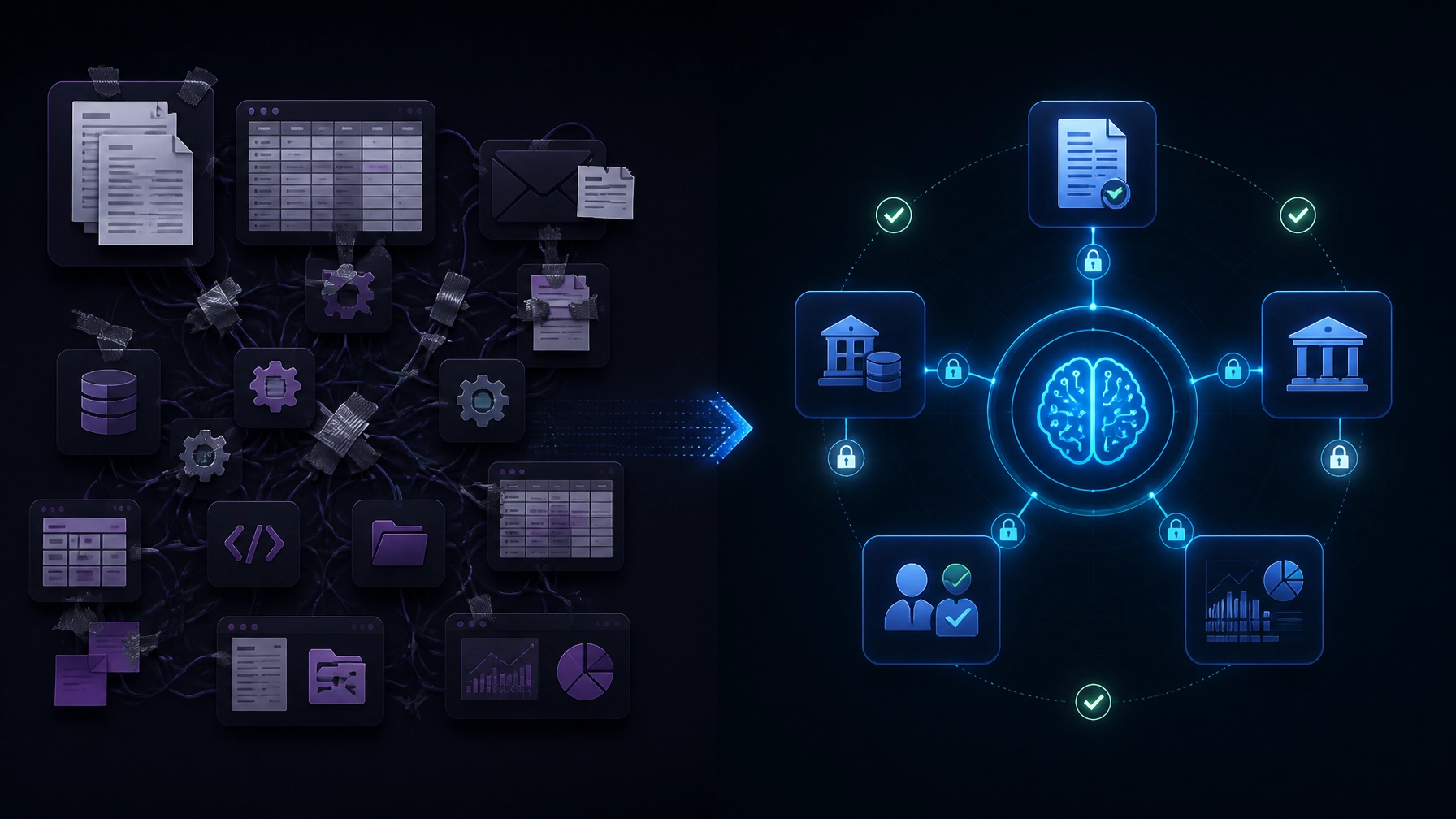
They have a patchwork of systems:
- ERP for accounting
- CRM for customer data
- Banking platforms for transactions
- Shared inboxes for invoices and requests
- Spreadsheets for reconciliations
- Document storage for approvals
- Email for exceptions
- Manual reports for leadership
These tools often work independently. They do not share business logic.
Your team becomes the integration layer.
Someone downloads a report from one system, cleans it in a spreadsheet, uploads it somewhere else, sends an approval email, updates a tracking sheet, and repeats the process when an exception appears.
That is the duct-taped tool stack.
It creates four direct financial problems:
- Labor cost increases. Skilled employees spend time on repetitive administration.
- Errors multiply. Manual entry creates incorrect coding, duplicate payments, missed approvals, and rework.
- Audit preparation expands. Your team searches for evidence instead of generating it automatically.
- Revenue and cash flow slow down. Invoices, approvals, collections, and decisions wait in queues.
Generic automation tools do not solve the underlying problem. They automate simple triggers while leaving complex logic to your people.
We do not build another disconnected workflow.
We build a system around your actual finance process, systems of record, approval rules, exception paths, and reporting requirements. Learn more about custom workflow automation with n8n, Python, and secure integrations.
10x productivity means 10x more throughput from the same team
The phrase “10x productivity” needs a precise definition.
For finance, use this formula:
> Productivity = Valuable output ÷ Human time required
A 10x improvement occurs when your team completes substantially more work with the same people and fewer manual steps.
It does not require a 90% headcount reduction.
In many cases, the financial value comes from capacity. Your team avoids hiring additional staff as transaction volume grows. Existing employees move from processing work to forecasting, analysis, controls, and strategic support.
Track productivity across five measures:
- Volume: Transactions, invoices, reconciliations, reports, or requests completed
- Cycle time: Hours or days from intake to completion
- Manual touches: The number of times a person moves, checks, or re-enters data
- Error rate: Corrections, exceptions, duplicate records, and rejected submissions
- Capacity: Hours redirected to higher-value finance work
Your baseline matters.
Before building anything, measure the current process for at least one representative operating period. Document the number of transactions, total labor hours, average handling time, error volume, and backlog.
Then compare the automated workflow against that baseline.
$250,000 of capacity can appear before one position is removed
Consider a representative finance workflow.
Your AP team processes 4,000 invoices each month. The process includes:
- Receiving invoices through email
- Extracting vendor and line-item information
- Matching invoices to purchase orders
- Routing exceptions
- Requesting approvals
- Entering data into the ERP
- Filing supporting documentation
- Preparing payment records
Assume the process consumes 1,000 staff hours per month across AP, procurement, department managers, and accounting.
If custom AI automation removes 70% of repetitive work, the system returns approximately 700 hours each month.
At a fully loaded labor cost of $60 per hour, that represents:
- $42,000 in monthly capacity
- $504,000 in annualized capacity
This is a representative scenario, not a promised result.
The actual value depends on your transaction volume, labor rates, exception rate, system access, and workflow complexity.
The CFO decision is not simply whether to eliminate jobs. It is whether the returned capacity produces measurable business value.
You can use that capacity to:
- Avoid future hiring
- Process higher transaction volume
- Accelerate close activities
- Improve cash forecasting
- Strengthen financial controls
- Support more business units
- Reduce reliance on contractors or overtime
The P&L impact appears when capacity becomes avoided cost, increased output, or improved margin.
40% fewer errors changes the cost structure
Manual finance work creates costs that rarely appear in the automation proposal.
An incorrect invoice may trigger:
- Rework by AP
- Follow-up from procurement
- A delayed payment
- A duplicate payment investigation
- A vendor dispute
- A missed early-payment discount
- An audit question
- A management escalation
A custom process automation system validates data before it enters the next system.
It can check:
- Vendor identity
- Purchase order matching
- Required fields
- Approval thresholds
- Duplicate invoice numbers
- Department or project coding
- Contract terms
- Payment dates
- Exception categories
The system routes unusual cases to a human. It does not force every transaction through the same path.
That distinction matters.
Generic tools follow a template. Custom AI automation follows your business rules.
Your ROI model should calculate error reduction using actual internal costs:
> Error reduction value = Baseline error cost − Post-automation error cost
Include labor, write-offs, payment issues, discounts missed, penalties, audit remediation, and management time.
Do not claim savings based on an industry benchmark alone. Measure the cost inside your own operation.
Audit readiness becomes a built-in operating control
Audit preparation becomes expensive when evidence is scattered across inboxes, spreadsheets, and disconnected systems.
Your team then spends weeks answering basic questions:
- Who approved this transaction?
- When did the approval occur?
- Which version of the document was used?
- Why was this exception accepted?
- What changed after the original submission?
- Which policy governed the decision?
Custom workflow automation records those details as the process runs.
A finance automation system can create:
- Timestamped approval records
- User and role information
- Document and data lineage
- Exception reasons
- Validation results
- Status changes
- Integration events
- Escalation history
- Human review decisions
That creates a usable audit trail instead of a pile of screenshots.
The financial benefit includes lower audit preparation effort, fewer control exceptions, and faster responses to auditors. It also gives you stronger operational visibility throughout the year.
Security must exist at the architecture level. Autom8ion Lab builds role-based access, encryption, audit logging, validation, and approval controls into the workflow from the beginning. Review our cybersecurity and compliance engineering capabilities.
Faster collections turn workflow speed into cash
Revenue acceleration does not always require more sales.
Sometimes it requires removing friction after the sale.
A custom AI automation system can support AR by:
- Monitoring invoice status
- Identifying missing information
- Classifying customer responses
- Routing disputes to the right owner
- Triggering collection reminders
- Updating CRM and ERP records
- Escalating overdue accounts
- Preparing account summaries for finance staff
Your team spends less time searching for context and more time resolving the issue.
This affects cash flow through:
- Faster invoice submission
- Fewer billing errors
- Shorter dispute cycles
- More consistent follow-up
- Better visibility into expected collections
Use your own DSO and dispute data to calculate the value.
For example:
> Working-capital benefit = DSO improvement × average daily revenue
A one-day improvement has a different value for a $10 million company than for a $100 million company. The calculation belongs in your operating model, not in a generic vendor pitch.
A four-week build creates a measurable starting point
You do not need to automate your entire finance department at once.
Start with one process that has high volume, clear rules, measurable friction, and accessible data.
Our standard workflow automation launch follows four stages:
Week 1: Map the current process
We document every handoff, approval, exception, system dependency, and manual touch.
You receive a baseline for:
- Labor hours
- Transaction volume
- Error rate
- Cycle time
- Backlog
- Audit evidence requirements
Weeks 2–3: Build the automation
We use n8n, Python, APIs, secure integrations, and custom orchestration to build around your systems.
The workflow includes:
- Business rules
- Data validation
- Approval routing
- Notifications
- Retry logic
- Exception handling
- Audit logging
- Role-based access
Week 4: Test real operating conditions
We test duplicate records, missing data, rejected approvals, failed integrations, unusual transactions, and incomplete submissions.
The system must handle the unhappy path. That is where generic automation usually fails.
Launch: Measure against the baseline
You receive documentation, operating procedures, and a scorecard for ongoing measurement.
Track results weekly:
- Hours saved
- Transactions completed
- Manual touches removed
- Errors prevented
- Exceptions resolved
- Cycle time reduced
- Cash accelerated
- Audit evidence created

Calculate ROI before you approve the project
Your business case should include all costs:
- Engineering and implementation
- Integrations
- Infrastructure
- AI usage
- Security controls
- Training
- Ongoing support
- Governance and monitoring
Then calculate benefits using your baseline data.
> ROI = (Annual benefits − Annual costs) ÷ Annual costs
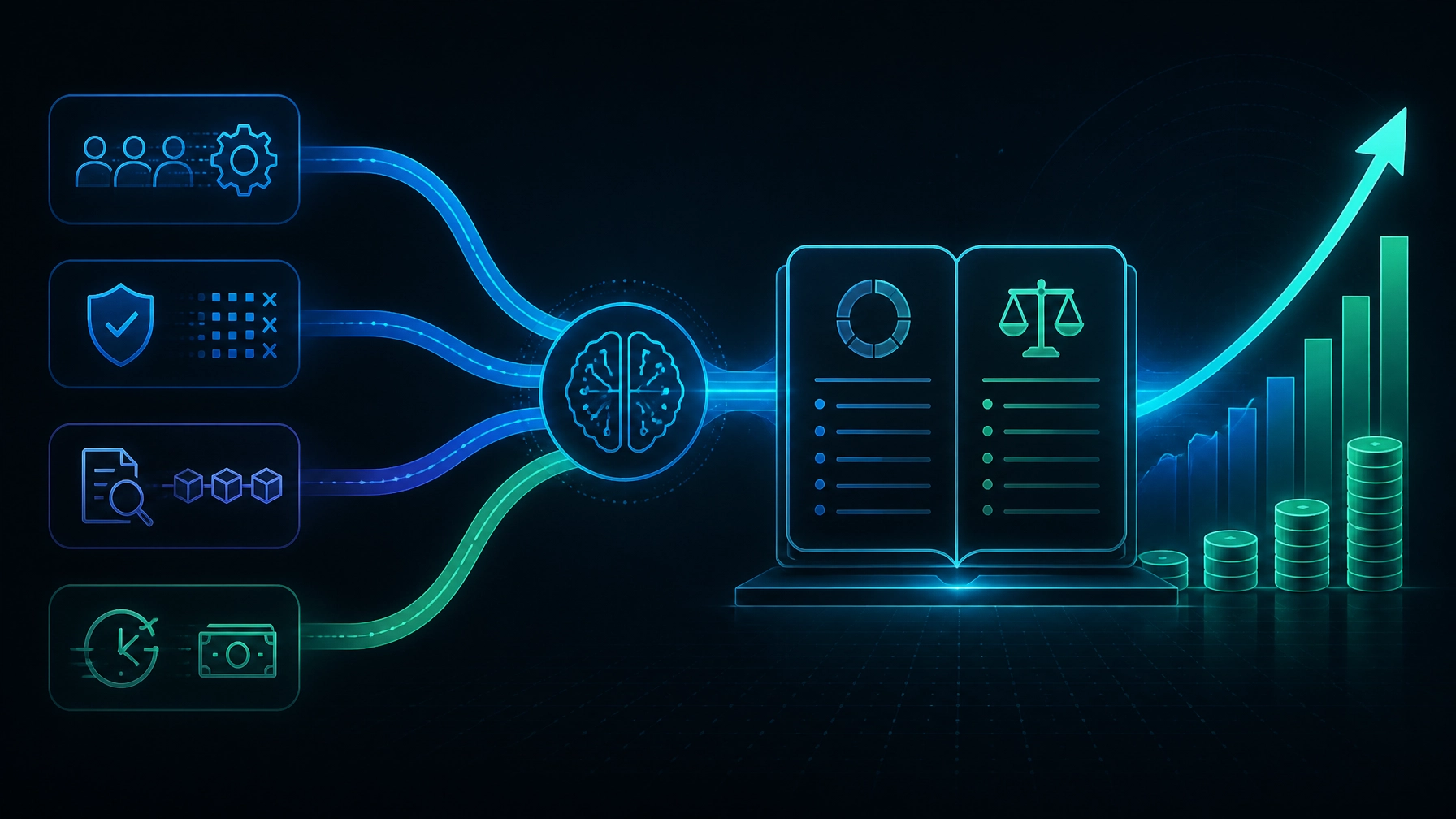
Separate the benefits into four categories:
- Labor capacity: Hours removed from repetitive work multiplied by loaded labor cost
- Error reduction: Lower rework, write-offs, exceptions, and remediation
- Audit readiness: Fewer preparation hours and control issues
- Revenue and cash flow: Faster billing, collections, approvals, and decisions
Do not use one blended productivity number and call the model complete.
Your CFO dashboard should show the operational drivers behind the financial result.
Custom AI automation belongs on the P&L when it changes operations
AI automation is not a software experiment.
It is an operating model decision.
The right system connects your data, applies your business logic, preserves control, and gives your team more capacity without adding more complexity.
We do not sell generic templates that force your finance process into someone else’s model.
We build custom AI automation, workflow automation, and process automation around your systems and your operating reality. Our average launch timeline is 30 days, with measurable performance tracking built into the deployment.
Want to see what a 10x productivity improvement looks like in your finance operation?
Schedule a capability briefing with our senior engineers. We will map the bottleneck, quantify the ROI, and tell you exactly what it takes to fix it.
Keep reading
Custom AI Systems for Private Equity Data Normalization
PE shops outsource data normalization to offshore shops because portfolio data lives in 14 different formats from 14 different management companies. Here is the custom LLM architecture that brings that work in-house — auditable, fast, and SOC 2-aligned.
12 min readWorkflow Automation for Compliance Teams: Turning Audit Season From a Fire Drill Into a Dashboard
Audit season exposes every broken process in your compliance program. Your team searches across inboxes, ticketing systems, cloud consoles, spreadsheets, shared drives, and security tools. Someone asks for access review evidence. Nobody knows who owns it. A.
7 min readWhy Your Construction Firm Is Losing Money in the Paper Trail (and How Custom AI Fixes It)
Your construction site is not losing money because your crews are slow. It is losing money in the gap between the field and the office. A superintendent captures a site condition in a notebook. A foreman sends a photo by text. A project manager receives an.
7 min readReady to Transform Your Business with AI Automation?
Let's discuss how custom automation solutions can deliver measurable results for your specific business needs.
Schedule a Consultation